
9. Environmental assets and patterns in West Suffolk
Key baseline data sources used in this section:
- National Planning Policy Framework 2024
- West Suffolk Local Plan 2024-2041
- Suffolk Local Flood Risk Management Strategy 2023
- West Suffolk Strategic Flood Risk Assessment March 2021
- Green Infrastructure Map
- UK Ambient Air Quality Interactive Map
- West Suffolk Biodiversity Duty Reporting Report 2026
- West Suffolk Tackling climate change
- Environment and Sustainability Reference Group
- Suffolk County Council Air Quality Strategy and Action Plan 2023
- Suffolk Local Nature Recovery Strategy 2025
- Suffolk Local Habitat Map
- West Suffolk Green Infrastructure April 2022
- Suffolk Green Access Strategy ROW improvement plan 2020-2030
- West Suffolk Strategic Environmental Assessment (SEA) Scoping Note 2026
Flood risk
9.1. Flood risk in West Suffolk arises from river flooding, surface water, groundwater, and reservoir failure, with higher-risk areas generally associated with the River Lark, River Little Ouse, River Stour, and their tributaries. The West Suffolk Strategic Flood Risk Assessments (Level 1, 2021 and Level 2, 2023) provides the most up to date evidence, assessing all sources of flooding, climate change impacts, and informing the application of the sequential and exception tests. The figures below show flood zones 2 and 3 and flood warning areas across the district.
9.2. Local flood risk from surface water and ordinary watercourses is managed through the Suffolk Local Flood Risk Management Strategy (2023), prepared by Suffolk County Council as Lead Local Flood Authority. Flood risk and sustainable drainage are addressed in the West Suffolk Local Plan 2024-2041, supported by national policy set out in the National Planning Policy Framework.
Figure 23: map showing flood zones 2 and 3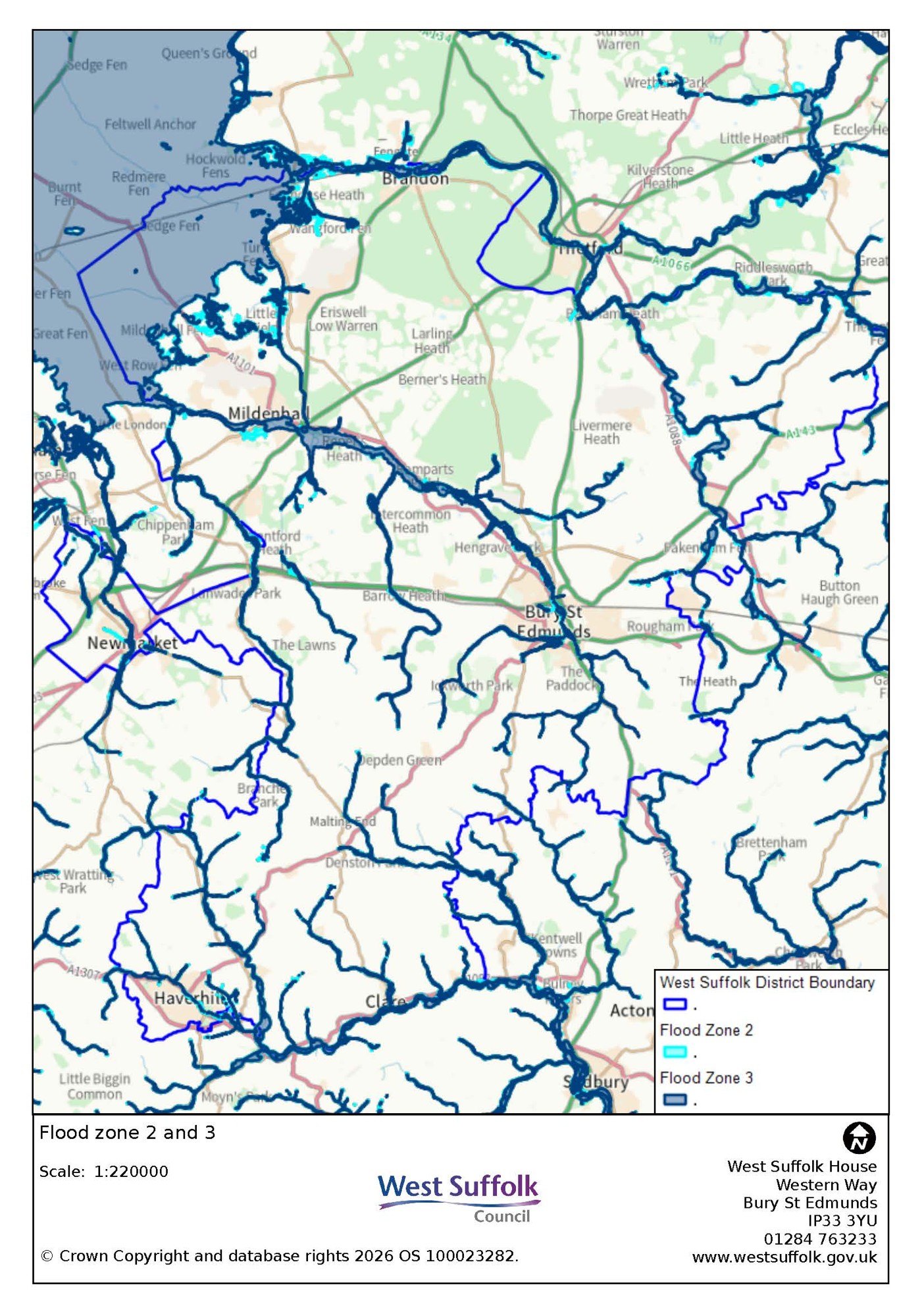
Source: Environment Agency
Figure 24: West Suffolk Flood Warning Areas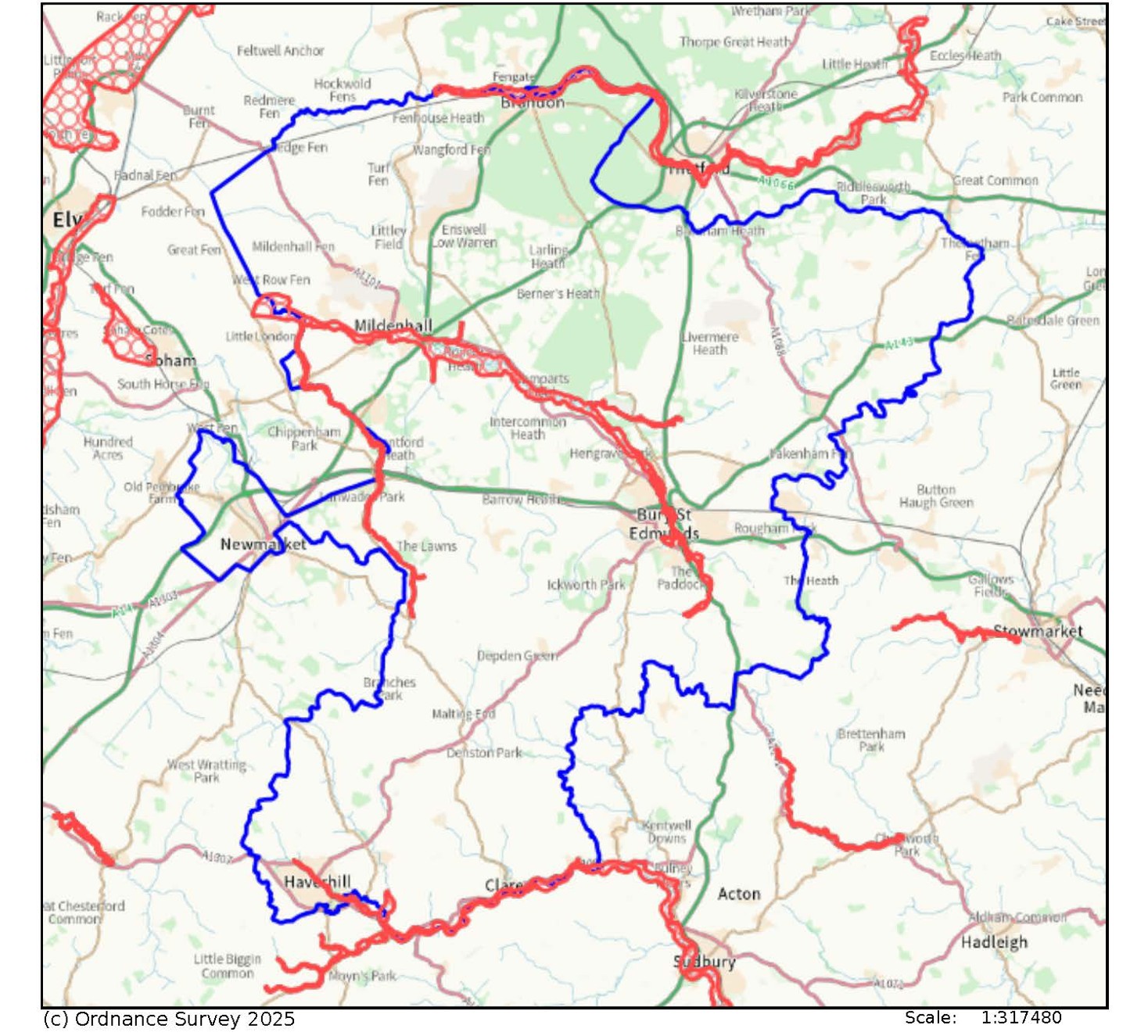
Source: Environment Agency data (The link is to live data)
Accessibility to green space
9.3. The West Suffolk Green Infrastructure Study (2022) highlights that West Suffolk is largely rural nature meaning that most of the district sits within an accumulation of open space deficiency for parks and gardens, amenity greenspace and natural and semi-natural greenspace. Good access to all three types of open space is generally limited to the district’s towns and larger villages. West Suffolk's network of public open space covers a variety of land uses and typologies. There is a total of 651 open space sites equating to approximately 736 hectares. Parks, amenity greenspace and natural greenspace are the largest contributors, accounting for 92 per cent of open space provision.
9.4. Natural England’s Accessible Greenspace Standard (ANGSt) provides a framework for assessing the availability, quality, and distribution of accessible natural green spaces. National mapping highlights variations in access to green infrastructure across West Suffolk, reflecting contrasts between the district’s main settlements, including Brandon, Bury St Edmunds, Haverhill, Mildenhall, and Newmarket, and its more rural areas. Supporting analysis, such as the ‘greenness grid’, illustrates differences in built and natural land cover and provides baseline evidence on accessibility and rurality.
Figure 25: shows screenshot of Natural England Green Infrastructure Framework interactive mapping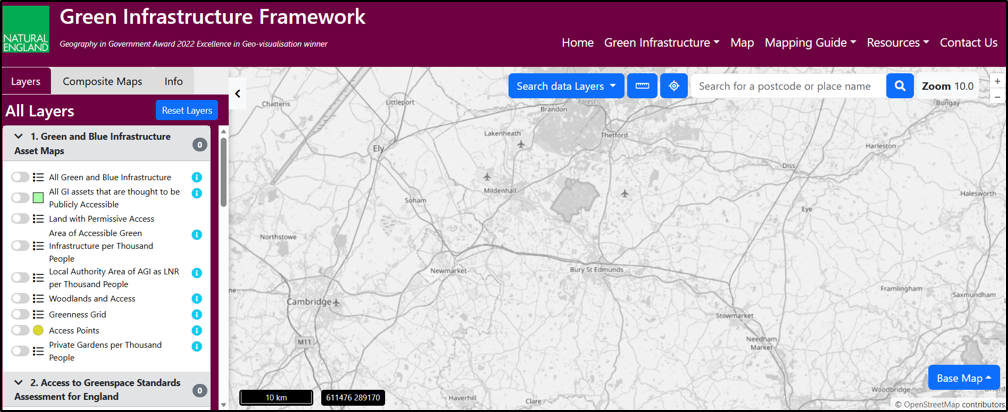
Source: Natural England Green Infrastructure Map
Air quality
9.5. Air quality in West Suffolk is influenced primarily by transport-related emissions, particularly nitrogen dioxide (NO₂). West Suffolk Council undertakes statutory air quality monitoring in accordance with national requirements. At present, the district has no designated air quality management areas and no smoke control areas.
9.6. The Suffolk Air Quality Strategy (2023) provides the county-wide framework for improving air quality, including actions relating to transport, development, and public health. The West Suffolk Local Plan 2024-2041 supports this approach through strategic objectives aimed at reducing the environmental impacts of development, including effects on air quality.
9.7. Department for Environment, Food and Rural Affairs' (Defra), in partnership with Greater London Authority and the Devolved Governments, has developed the UK Air Local Air Quality Dashboard, an interactive tool that presents local air quality information using national and local monitoring data. The dashboard tool allows users to search by postcode and view mapped data on pollutant concentrations and monitoring locations.
9.8. Department for Environment, Food and Rural Affairs' (DEFRA) national modelled quality maps provide estimated background pollutant concentrations across England, and the map below illustrates spatial variations in air quality across West Suffolk, including areas without monitoring sites.
Figure 26: West Suffolk air quality monitoring sites.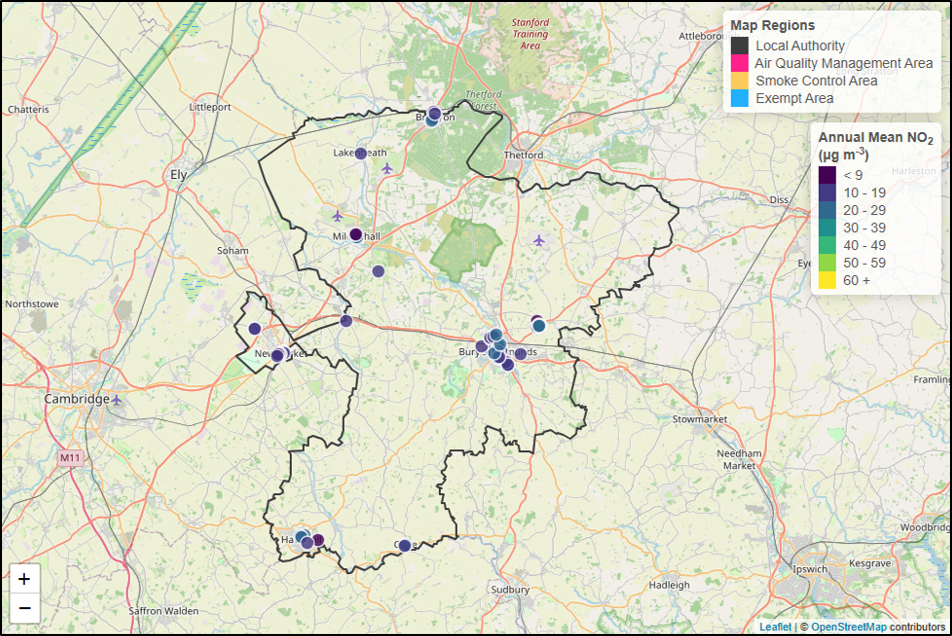
Source: UK AIR Local Air Quality Dashboard
Nature conservation designations and habitats
9.9. Within the district and immediately adjacent there are several internationally, nationally and locally important sites that will be protected. Internationally and nationally important sites include Ramsar sites, special protection areas, special areas of conservation, sites of special scientific interest (SSSI), geological SSSIs and national nature reserves. There are also other areas of biodiversity or geodiversity interest of local importance in both the countryside and built-up areas which merit protection. These sites include local nature reserves, county wildlife sites, county geodiversity sites, and other sites including ancient and semi-natural woodland, veteran trees, rivers floodplains and wetlands.
9.10. There are a number of special areas of conservation (SAC) and one special protection area (SPA) within West Suffolk. These are European designations which are protected by the Conservation of Habitats Regulations 2017 (as amended). Breckland Special Protection Area (SPA) is located to the north-west of the district and is designated because during the breeding season it supports populations of nightjar, woodlark and stone curlew which are of national importance. The SPA extends beyond the district boundary into Norfolk and is made up of Breckland Farmland SSSI, Breckland Forest SSSI and a number of heathland SSSI’s.
Figure 27: map showing special areas of protection and conservation in West Suffolk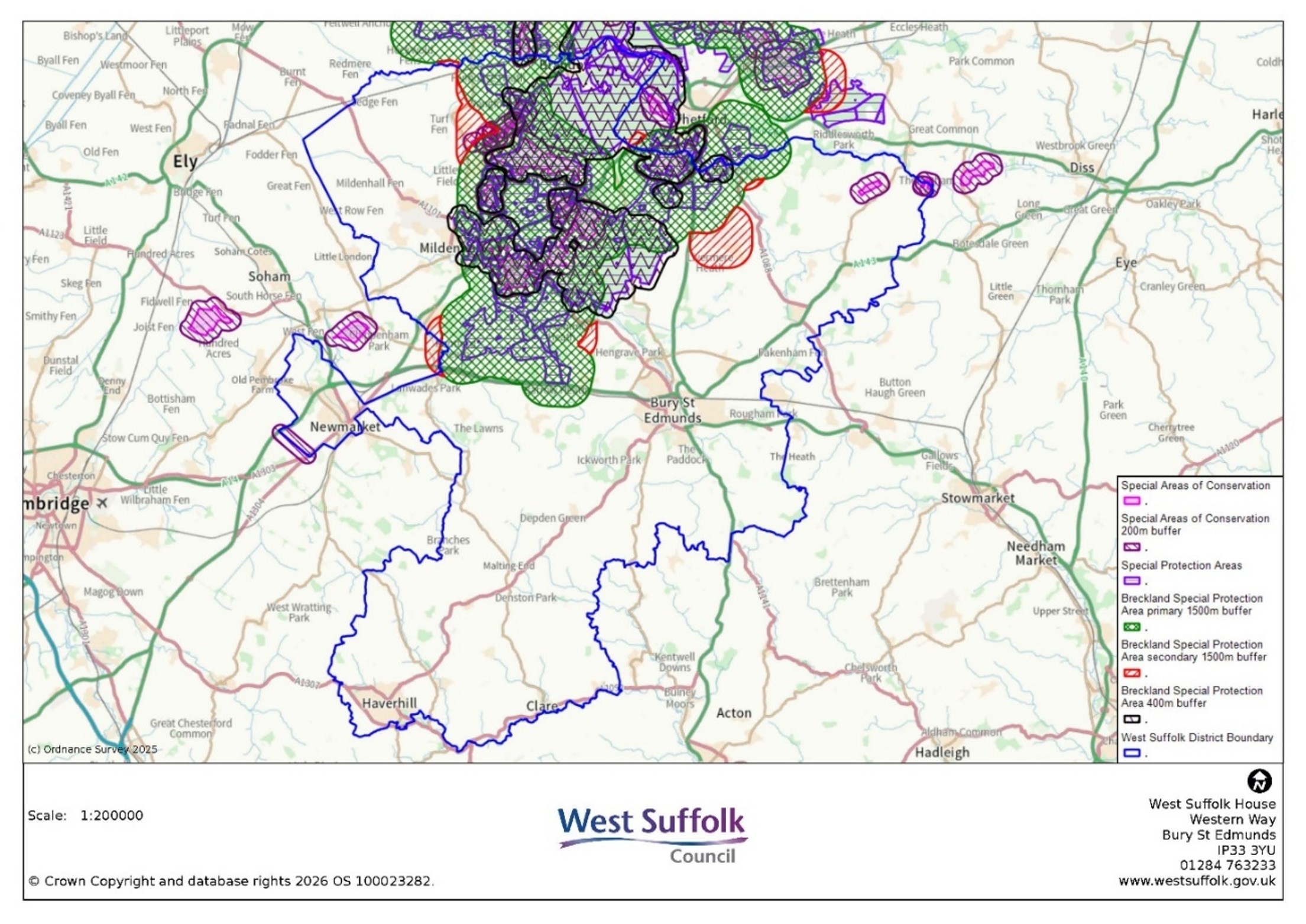
Source: West Suffolk Council
9.11. The biodiversity or geodiversity value of these areas will be taken into account when considering any future development proposals.
9.12. Suffolk’s Local Nature Recovery Strategy identifies priority locations where actions to restore and enhance biodiversity could have the greatest impact. Part D of the strategy, ‘Locations for action’, maps areas of particular importance for biodiversity (APIB) and areas that could become of particular importance for biodiversity (ACB). Within West Suffolk, APIB areas currently cover 20 per cent of West Suffolk, with a further 28 per cent identified as ACB. APIB areas can be found throughout West Suffolk. However, there is a particular concentration in the north of the district, as showed on figure 29
Figure 28: local habitat map identifying areas of importance for biodiversity in West Suffolk.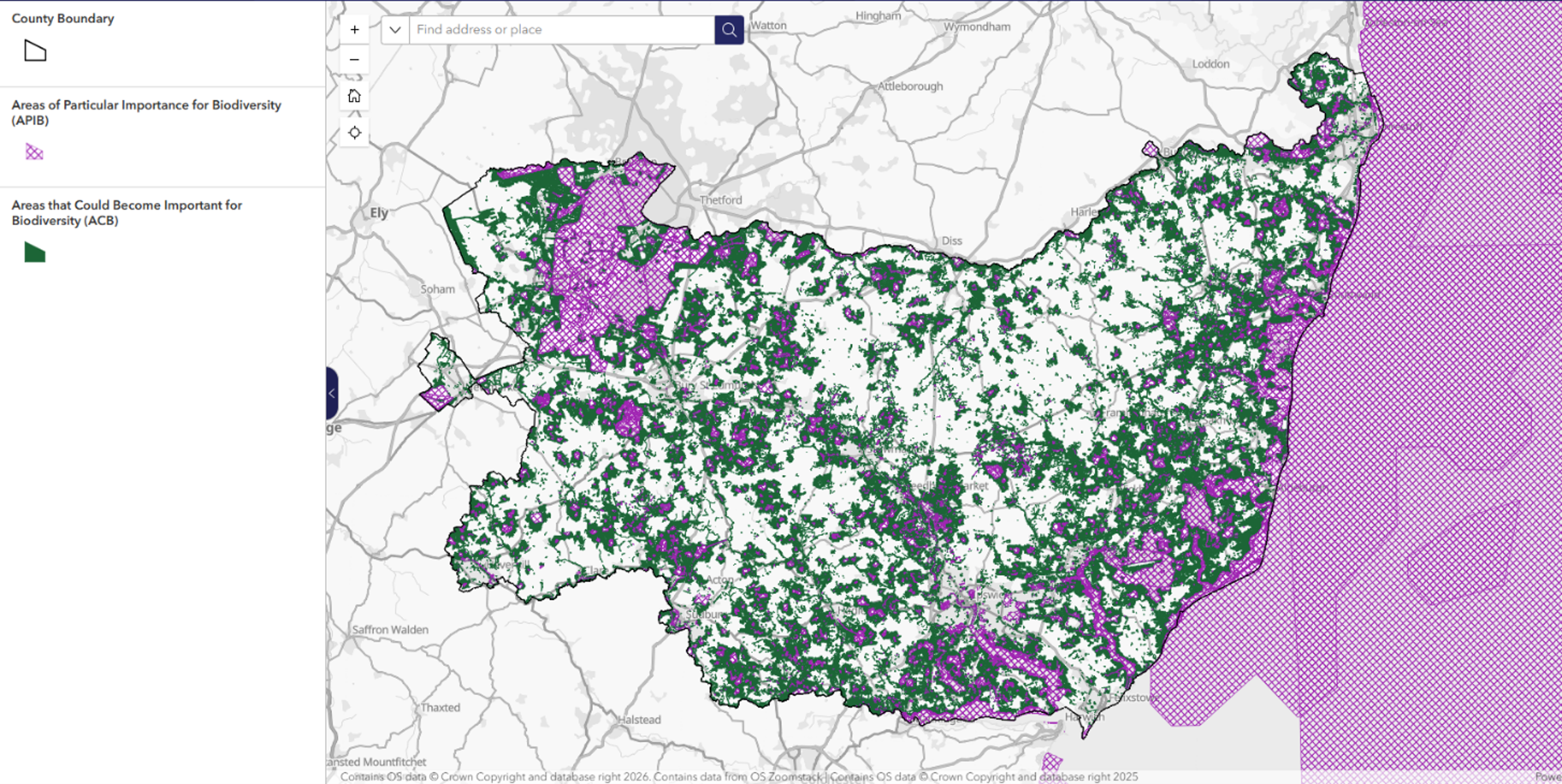
Source: Suffolk Local Habitat Map
9.13. With significant ecological and recreational assets within the district, often within very close proximities of each other, management of the competing demands of wildlife and leisure is a key issue.
Effects of climate change
9.14. Evidence from the Met Office indicates long-term climate trends including rising temperatures, wetter winters, fewer frost days, longer growing seasons, and an increased frequency of intense rainfall events. The Environment Agency also identifies West Suffolk as a ‘serious water stressed area’ which Anglian Water highlights that this makes vulnerable to climate change. These changes present challenges and opportunities for West Suffolk, particularly in relation to flood risk management, agriculture, and development resilience. West Suffolk Council has established governance and monitoring arrangements through its Environment and Sustainability Reference Group, Environment and Climate Change Action Plan, Net Zero Roadmap (published 2025), and Biodiversity Duty Report (2026), which together provide the corporate and spatial planning context for addressing climate change and biodiversity within the district.
Figure 29: West Suffolk Council Net Zero Roadmap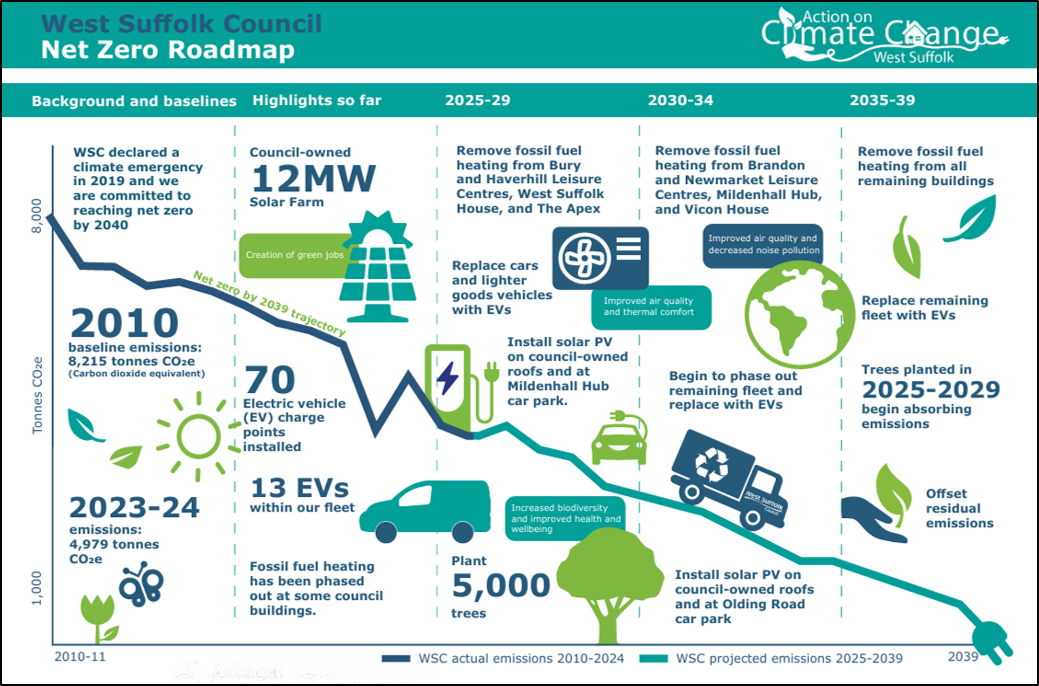
Source: Net-Zero-Road-Map.pdf
Back to West Suffolk Local Plan 2045 Baseline Data 2026 homepage
