
5. Housing in West Suffolk
Key baseline data sources used in this section
- West Suffolk Strategic Environmental Assessment (SEA) Scoping Report 2026
- Assessment of the supply of housing land in West Suffolk December 2025
- West Suffolk Authority Monitoring Report 2024 to 2025
- Housing Needs of Specific Groups Cambridgeshire and West Suffolk 2021
- West Suffolk Annual Infrastructure Funding Statement 2025
- West Suffolk Gypsy and Traveller and Travelling Showperson Accommodation Assessment 2023
- National Planning Policy Framework 2024
The housing need
5.1. The Government sets a standard method for calculating the housing need for each council area. This establishes the minimum housing need for West Suffolk is calculated as 1194 homes per year. This figure is updated regularly, as the variables informing it change over time, therefore it is likely to change as the local plan progresses. The latest figure represents a considerable uplift on the housing need planned for in the adopted West Suffolk Local Plan of 765 homes per year.
Progress to deliver housing compared to adopted housing requirement
5.2. As of April 2025, West Suffolk can demonstrate a six-year housing land supply. The five-year housing requirement is 3,825 homes, based on providing 765 homes a year, plus a shortfall of 148 homes and a five per cent buffer of 198.65 homes. The total deliverable housing supply is 5,009 homes, and means the council currently meets national policy requirements. This positive position is reflected in recent housing delivery trends as shown in figure 17 below: completions peaked at 1003 homes in 2022 to 2023, fell to 611 in 2023 to 2024, and increased again slightly to 617 in 2024 to 2025. Most completions have been in the main towns, and the recent completions demonstrates sites are continuing to come forward.
Figure 16: shows net housing completions between 2011 and 2025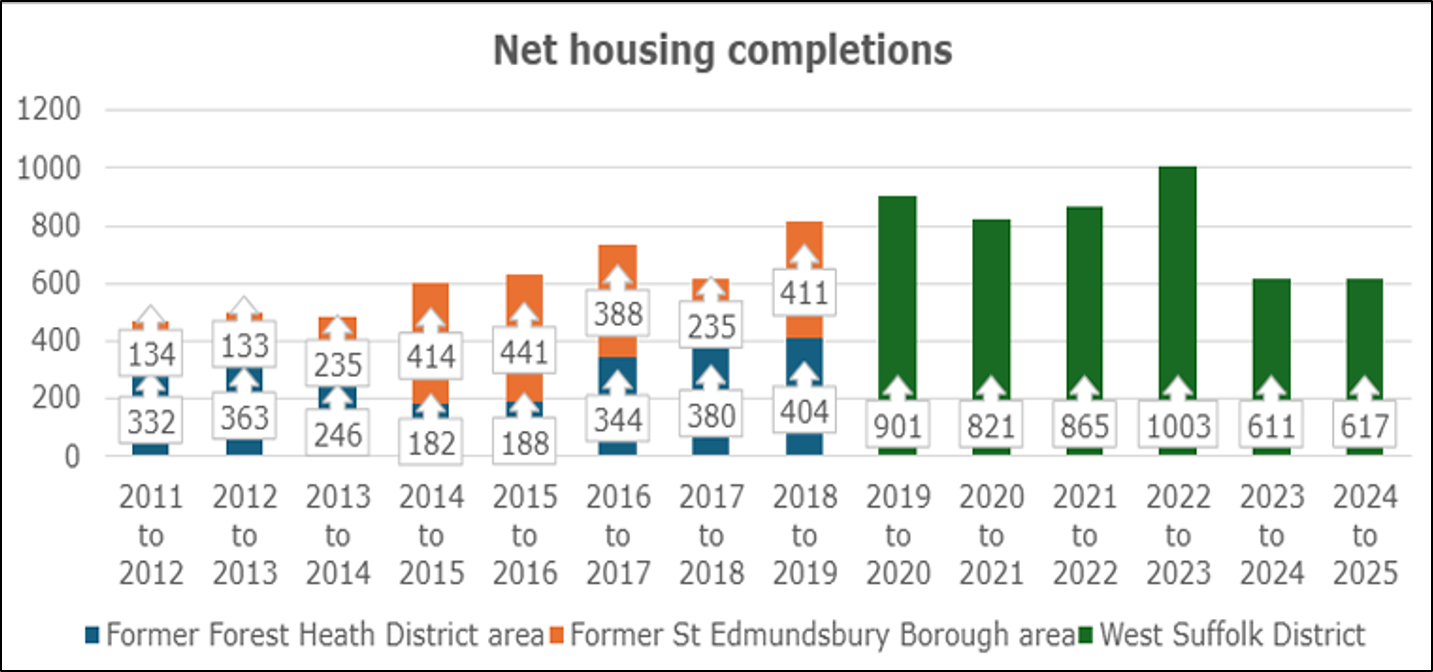
Source: West Suffolk Authority Monitoring Report 2024 to 2025
Affordable housing delivery
5.3. Affordable housing is defined in national guidance as housing for sale or rent, for those whose needs are not met by the market, including housing that provides a subsidised route to home ownership and/or is for essential local workers. The size, type and tenure of housing needed for different groups in the community should be assessed and reflected in planning policies, which includes those who require affordable housing and the needs of essential local workers. West Suffolk’s affordable housing need is to provide 505 rented homes per annum between 2023 and 2040.
5.4. Overall affordable housing delivery in West Suffolk has varied over time, with recent data showing fluctuations in the number of affordable houses delivered as shown in figure 18 below. Since the creation of West Suffolk Council, affordable housing delivery has remained at a relatively consistent level, peaking at 327 in 2019 to 2020 and staying around 250 homes. While there is a steady level of affordable housing provision, delivery remains below identified need, highlighting the importance of meeting demand across the district.
Figure 17: shows the actual number of affordable homes (as defined in the national planning policy framework) supplied in West Suffolk from 2011 to 2025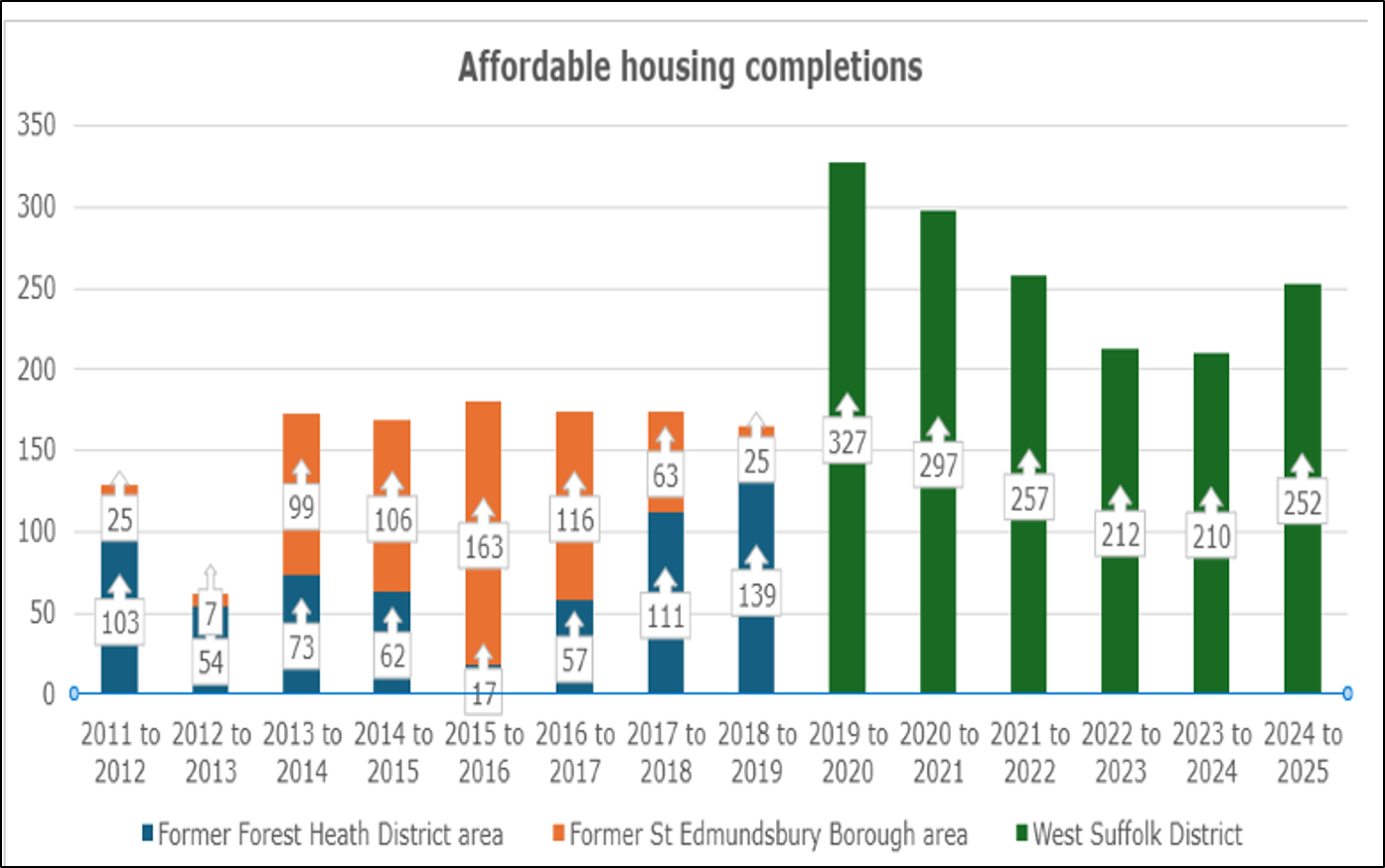
Source: West Suffolk Authority Monitoring Report 2024 to 2025
5.5. Between April 2024 and April 2025, West Suffolk Council secured 206 affordable homes under section 106 agreements, of which 63 are affordable homes to be provided by a registered housing provider. This means the council achieved its policy target of 30 per cent affordable housing across all related section 106 agreements signed during the year. Section 106 obligations were also secured in relation to two new care homes and two commercial sites.
Housing prices
5.6. Housing prices in West Suffolk have increased over the longer term although there has been recent softening with median house prices reducing from £325,221 in March 2025 to £294,000 in September 2025. As shown on table 2 below, house prices in West Suffolk remain below the East of England average but are broadly comparable to national levels. The ratio of median house prices to median workplace-based earnings has remained high, peaking in 2022 at 9.86 per cent, the latest figures (2025) show 7.73 per cent and the five-year average is 8.95 per cent. This has implications for housing need and affordable housing delivery.
Table 2: shows average house prices 2020 to 2025
| Former Forest Heath District Council (FHDC) area | Former St Edmundsbury Borough Council (SEBC) area | West Suffolk | East of England | National | |
|---|---|---|---|---|---|
| June 2020 | £250,334 | £300,862 | £351,705 | ||
| June 2021 | £277,879 | £347,971 | £389,268 | ||
| June 2022 | £298,274 | £347,448 | £408,797 | ||
| June 2023 | £296,227 | £342,790 | £412,943 | ||
| June 2024 | £285,225 | £340,808 | £411,633 | ||
| March 2025 | £337,669 | £416,584 | £357,816 |
Source: Cambridge insight housing market bulletins (March 2025 data taken from edition 65 published June 2025
Specialist housing delivery
Communal and/or co-living housing
5.7. Meeting identified specialist housing needs will require a diverse range of homes. A projected 55 per cent increase in the population aged over 65 is expected to increase demand for supported housing and care homes, requiring 1,761 care bed spaces and 3,176 units of older persons’ housing over the period 2020 to 2040. Delivery will need to meet the need for accessible homes, including 1,872 wheelchair user homes. Future housing delivery will need to provide a mix of tenures to meet existing and future need.
Travellers
5.8. West Suffolk’s Gypsy and Traveller need to 2041 has been identified as an overall cultural need of 39 pitches. No need has been identified for travelling show people, boat dweller or other caravan dwellers accommodation in this period. The full cultural need for 39 pitches will be met through the intensification of, or extension to, existing sites and the regularisation of existing tolerated pitches.
5.9. West Suffolk has 98 permanent traveller pitches, on 20 sites at various locations across the district. There is one occupied travelling show person’s yard.
Service personnel and families
5.10. West Suffolk is home to three RAF bases: RAF Lakenheath, RAF Mildenhall which are home to the United States Air Force in Europe (USAFE) and RAF Honington. While the sites have their own accommodation, the bases drive the local rental markets, with rental prices significantly uplifted due to military housing allowances.
5.11. The Housing needs of specific groups Cambridgeshire and West Suffolk report highlights that RAF and USAFE representatives reveal a demand for bespoke build-to-rent schemes to accommodate the military personnel off bases. Requirements are locations close to the bases and with good transport links.
5.12. At present, there are small numbers of service families on the council’s housing register. West Suffolk will continue to monitor the registers to identify any future needs, as the National Planning Policy Framework require local planning authorities to assess the future specialist housing needs as part of the housing needs assessment.
Homelessness
5.13. Homelessness is associated with severe poverty and is a social determinant of health. It often results from a combination of events such as relationship breakdown, debt, and adverse experiences in childhood and through ill health.
5.14. The West Suffolk Homelessness Reduction and Rough Sleeping Strategy highlights that during 2023 to 2024, 315 households in West Suffolk were threatened with homelessness and a further 575 were already recorded as homeless. Successful prevention (49 per cent) and relief (26.1 per cent) rates are below national averages (51 per cent and 31.2 per cent respectively).
5.15 West Suffolk has utilised central Government funding to deliver services and accommodation to tackle homelessness in the district. Including £1.3 million for the Rough Sleeper Initiative fund to provide rough sleeper beds and support staff. The district is taking a preventative approach to homelessness by aiming to prevent people from ending up on the street in the first instance and that where it does occur, it is brief and non-recurrent.
Back to West Suffolk Local Plan 2045 Baseline Data 2026 homepage