
6. Key infrastructure delivery in West Suffolk
Key baseline data sources used in this section:
- West Suffolk Infrastructure Delivery Plan 2025
- Developers Guide to Infrastructure Contributions in Suffolk August 2025
- Suffolk County Council Infrastructure Funding Statement 2024 to 2025
- Suffolk Bus Service Improvement Plan 2024
- Transport East Transport Strategy 2023-2050
- Suffolk County Council Local Transport Plan 2025-2040
- West Suffolk Strategic Environmental Assessment (SEA) Scoping Report 2026
- West Suffolk Annual Infrastructure and Funding Statement 2024 to 2025
- Suffolk Green Access Strategy ROW improvement plan 2020-2030
- The Suffolk local Cycling and Walking Infrastructure Plan (LCWIP) 2021
- West Suffolk Transport Mitigation Report 2024
- Connectivity tool
West Suffolk Infrastructure Delivery Plan
6.1. West Suffolk published the infrastructure delivery plan (IDP) alongside the adopted West Suffolk Local Plan 2024 to 2041. The IDP details the larger pieces of infrastructure required to support planned growth. The scope of the IDP reflects national planning policy and guidance, best practice in the provision of infrastructure and engagement with the relevant service providers. The infrastructure types addressed (listed in table 3 below) include both local services and those that are strategic in nature.
Table 3: shows infrastructure types and responsibility
| Infrastructure type | Subcategory | Responsibility |
|---|---|---|
| Education | Early years Primary Secondary Further education | Suffolk County Council |
| Health | GPs Secondary health care Mental health Older age care | Integrated Care Board NHS Suffolk County Council |
| Highways | Roads Rail Bus networks Footpaths Cycleways Sustainable transport | All Suffolk County Council aside from Network Rail’s rail responsibilities National Highways |
| Community facilities | Libraries Community centres Village halls | Suffolk County Council West Suffolk Council and/or parish or town council |
| Green infrastructure | Open spaces Outdoor sports ndoor sports and leisure centres Play facilities | West Suffolk Council and/or private company Parish and Town Councils |
| Utilities | Electricity Gas Water Sewerage Renewables Broadband | Utilities providers |
| Waste and recycling | Landfill Recycling | Suffolk County Council |
| mergency services | Ambulance Police ire and rescue | East of England Ambulance Service Suffolk Constabulary Suffolk County Council |
| Flood risk and drainage | Flooding Surface flood | Environment Agency Anglian Water Suffolk County Council – local lead flood authority |
Source: West Suffolk Infrastructure Delivery Plan 2025
6.2. It is worth noting that the future responsibilities for delivery of infrastructure will change through the upcoming local government reorganisation (LGR) with the creation of unitary authorities.
West Suffolk Infrastructure Funding Statement 2024 to 2025
6.3. Infrastructure Funding Statement in June 2025. The infrastructure delivery plan should be read in conjunction with the latest infrastructure funding statement, which sets out all developer obligations (funds) already secured for new or enhanced infrastructure across the district from new developments and how and when it will be spent.
6.4. Under section 106 of the Town and Country Planning Act 1990 (s106) a local planning authority (LPA) can seek planning obligations, both physically on-site and contributions for off-site, when it is considered that a proposed development will have a negative impact, that cannot be dealt with by attaching conditions to the planning permission. Planning obligations aim to reduce this additional pressure on existing social, physical, and economic infrastructure in the surrounding area, by securing improvements to the infrastructure. S106 obligations may restrict the development or use of land, require specified operations, provisions, or activities to be carried out and/or require a sum of money to be paid.
6.5. The opening balance for 2024 to 2025 was £6,146,331.29 for infrastructure projects but nearly a quarter of this money is held for future maintenance of public open space areas, such as play areas. See appendix 1 for all s106 monies received in 2024 to 2025.
6.6. In the financial year 2024 to 2025 £1,678,674.09 was spent on various projects listed in appendix 4 and the council have also allocated £2,887,336.68 to be spent on various projects as they come forward (appendix 3). This leaves a much smaller sum of money from previous years, yet to be allocated. Allocating s106 monies often relies on pooling other s106 sums which may not have been received yet so that is why the council often has a number of years to spend the money.
Suffolk County Council Infrastructure Funding Statement 2024 to 2025
6.7. Suffolk County Council is responsible for delivering and maintaining and delivering types of infrastructure across Suffolk as a whole such as roads, schools, waste disposal services and libraries and plays a vital role in the provision of infrastructure in West Suffolk.
6.8. Suffolk County Council last published their Infrastructure Funding Statement (IFS) in November 2025 summarising the funding secured, held and spent for transport infrastructure, education, community facilities, waste management, social care, library and youth services, flood risk management and environmental mitigation measures. The IFS highlights the planning obligations which have been agreed, held or spent on infrastructure in Suffolk.
6.9. The Suffolk County Council’s Developers Guide to Infrastructure Contributions in Suffolk (published August 2025) sets out the Suffolk approach for determining what is necessary to mitigate the impact of individual developments and the expectations for section 106 planning obligations. The content of the developer’s guide has been used to inform the schedules for West Suffolk infrastructure delivery plan (
6.10. £23,404,350.46 was received during Suffolk County Council's reported year. These contributions either fund part of all project costs and are allocated in accordance with the clauses of the legal agreement. A large proportion of the funding received will fund new schools and school expansions to accommodate the population growth. This is also evident in table 4 showing examples of section 106 contributions spent in West Suffolk, which includes several education contributions.
Table 4: shows examples of section 106 contributions spent in West Suffolk, including education contributions
| Obligation | Local planning application reference | Expenditure amount | Parish |
|---|---|---|---|
| Primary education contribution | SE/13/0526 | £569,701.33 | Fornham All Saints CP |
| Public transport provision contribution | DC/14/1881/HYB | £26,961.44 £22,508.54 £22,776.26 £17,252.48 | Rushbrooke with Rougham CP |
| Travel plan contribution | DC/14/1881/HYB | £33,012.81 | Rushbrooke with Rougham CP |
| Library contribution | DC/19/1652/OUT | £47,597.75 | Fornham All Saints CP |
| Primary education contribution (Abbotts Green Primary School) | DC/14/1881/HYB | £419,350.03 | Rushbrooke with Rougham CP |
| Secondary school contribution sixth form (new Moreton Hall Secondary School) | DC/14/1881/HYB | £373,749.58 £82,653.27 | Rushbrooke with Rougham CP |
| Primary school capital contribution | F/2013/0394/OUT | £54,179.82 £51,331.70 | Lakenheath CP |
| Education contribution (West Row) | DC/17/1107/FUL | £51,035.10 | Beck Row, Holywell Row and Kenny Hill CP |
| Secondary school contribution | DC/19/2482/FUL | £26,537.02 | Mildenhall CP |
| Education contribution | DC/15/2298/FUL | £48,367.12 | Hopton CP |
| Primary school contribution (St Edmundsbury CEVA Primary) | DC/15/0689/OUT | £42,904.92 | Bury St Edmunds |
| Tollgate Lane junction works contribution | SE/13/0526 | £17,109.05 | Fornham All Saints CP |
| Western Way contribution | DC/18/0464/FUL | £26,202.58 | Bury St Edmunds |
| Secondary school contribution | DC/18/0614/FUL | £81,755.55 | West Row CP |
| Pre-school contribution | DC/19/0479/FUL | £23,181.57 | Haverhill CP |
| Pre-school contribution – Feoffment | DC/13/0906/FUL | £33,861.23 | Bury St Edmunds |
| Sixth form contribution – King Edward VI CEVC Upper School | DC/13/0906/FUL | £23,789.57 | Bury St Edmunds |
| Tollgate Lane junction works contribution | SE/13/0526 | £28,560.47 | ornham All Saints CP |
Source: Suffolk County Council Infrastructure Funding Statement 2024-2025
Please note that the examples in table 4 are infrastructure contributions spent in West Suffolk from the Suffolk County Council infrastructure funding statement. The full table for the county can be viewed in appendix 3, page 38.
6.11. Other legal agreements that can fund infrastructure are section 278 highway agreements. Legal agreements pursuant to section 278 of the Town and Country Planning Act 1990 will secure commitments from the developer to deliver the necessary highways infrastructure for their development, whilst also arranging for a surety to hold a financial bond, which can be drawn down by the local highways authority, if for any reason the developer is unable to complete the highways works. This then provides certainty of delivery for critical infrastructure. Suffolk County Council is the local highway authority in West Suffolk, so they are responsible for securing the required section 278 agreements. View the agreements secured and monies spent in 2024 to 2025 in appendix 5 – Section 278 Agreements, page 80.
Public transport
6.12. Buses in West Suffolk are run by franchises and include Mulleys, Stephensons and Stagecoach. A regular bus service is an important part of maintaining a sustainable settlement. This allows people to reduce journeys by car and access services and facilities outside their immediate locality.
6.13. In 2023 there were 12.2 million bus journeys made in Suffolk marking a steady growth back towards the pre-pandemic figure of 15.2 million in 2019. This demonstrates the important role which buses play in providing transport for people to get to work, education, medical appointments, shopping and leisure activities. However, the dispersed, rural population distribution in Suffolk makes commercial operation outside of the three main towns difficult to sustain.
6.14. In June 2024 Suffolk County Council published the latest Bus Service Improvement Plan (BSIP) that aims to deliver better bus services and facilities and support bids for funding. The latest bus service improvement plan has been developed by the partners represented on the Enhanced Bus Partnership Board, taking into account the views of many other stakeholders, including the public. This resulted in over 65 suggestions and ideas of which 46 per cent were local bus operator led; 15 per cent were district or parish council led; and 39 per cent were joint bids between councils and operators. Community led flexible style services specifically designed to support rural village connections to larger settlements accounted for 16 per cent of submissions (11 schemes) being taken forward.
6.15. Suffolk County Council will be working with the stakeholders to refine the concepts up to the point where implementation will be straightforward when further funding becomes available. In 2025 to 2026 the Government have awarded Suffolk County Council a combined £8,774,816 Bus Service Improvement Plan (BSIP) and Bus Service Operators Grant (BSOG) allocations, to provide bus service improvements. (Bus funding allocations 2025 to 2026)
6.16. There are several rail stations and/or stops serving West Suffolk including Bury St Edmunds, Newmarket, Lakenheath, Brandon and Kennett (located in East Cambridgeshire). The East West Rail Eastern Section Prospectus notes that, ‘to realise ... full economic and housing growth potential, services from Norfolk and Suffolk to Cambridge must be more frequent and journey times improved. This will be crucial for Cambridge and West Suffolk, as West Suffolk forms part of the housing sub-region for the Cambridge workforce.’ Improved rail services can encourage a modal shift from the car onto rail for short and long-distance commuter journeys thereby reducing city centre congestion and allowing housing and economies in key growth locations to grow more sustainably. (East West Rail Consortium 2019)
6.17. Transport East is the sub-regional transport body for Suffolk, Norfolk, Essex, Thurrock and Southend on Sea. Transport East facilitates collaboration between local councils, National Highways, Network Rail and the Department for Transport, as well as other strategic partners such as ports, airports and rail and bus operators from across the East. The Transport East Transport Strategy 2023 to 2050 details a vision for the future of transport up to 2050 and four strategic priorities that will enable the delivery of the vision.
6.18. Suffolk County Council’s Local Transport Plan 2025-2040 reflects the vision and priorities of Transport East and includes policies and interventions that contribute to achieving the goals set out within the transport strategy. The strategy is supported by a Strategic Investment Programme (SIP) which sets out the priority transport programmes and projects for the region.
Cycle routes
6.19. West Suffolk benefits from an extensive public right of way (PRoW) network that is most developed within and between urban areas, while also providing good connections to rural locations in the south, east and west of the district. This infrastructure is part of Suffolk’s wider Green Access Network, which is one of the most extensive in England and includes over 3,500 miles of footpaths, bridleways, and byways.
6.20. A number of active travel improvements proposed by Suffolk County Council that are supported by the Department for Transport’s Active Travel Fund and Suffolk County Council has been awarded over £10 million since February 2020 to deliver schemes across the county. There are four active travel proposals within West Suffolk being considered for funding in West Suffolk, all four are located in Bury St Edmunds. The county council identify and improve the cycle routes in the county to ensure increased access to services, sustainable transport options and health and wellbeing for residents.
6.21. The Suffolk Local Cycling and Walking Infrastructure Plan (LCWIP) 2021 acts a countywide framework for improving the provision of walking and cycling routes. The LCWIP has identified a prioritised list of potential walking and cycling schemes that would provide improvements to the networks described above. In West Suffolk routes have been identified in Bury St Edmunds, Haverhill, Mildenhall and Newmarket
6.22. The connectivity tool shows the overall cycle route accessibility for residents in the district, scoring in the middle for the main towns and become increasingly darker for the rural areas, indicating less access to services, work and residential areas. For accessibility to education, health and leisure the connectivity scores very low in the rural areas, showing the dependency on road and public transport for residents outside of the main towns.
Figure 18: overall cycle route connectivity in West Suffolk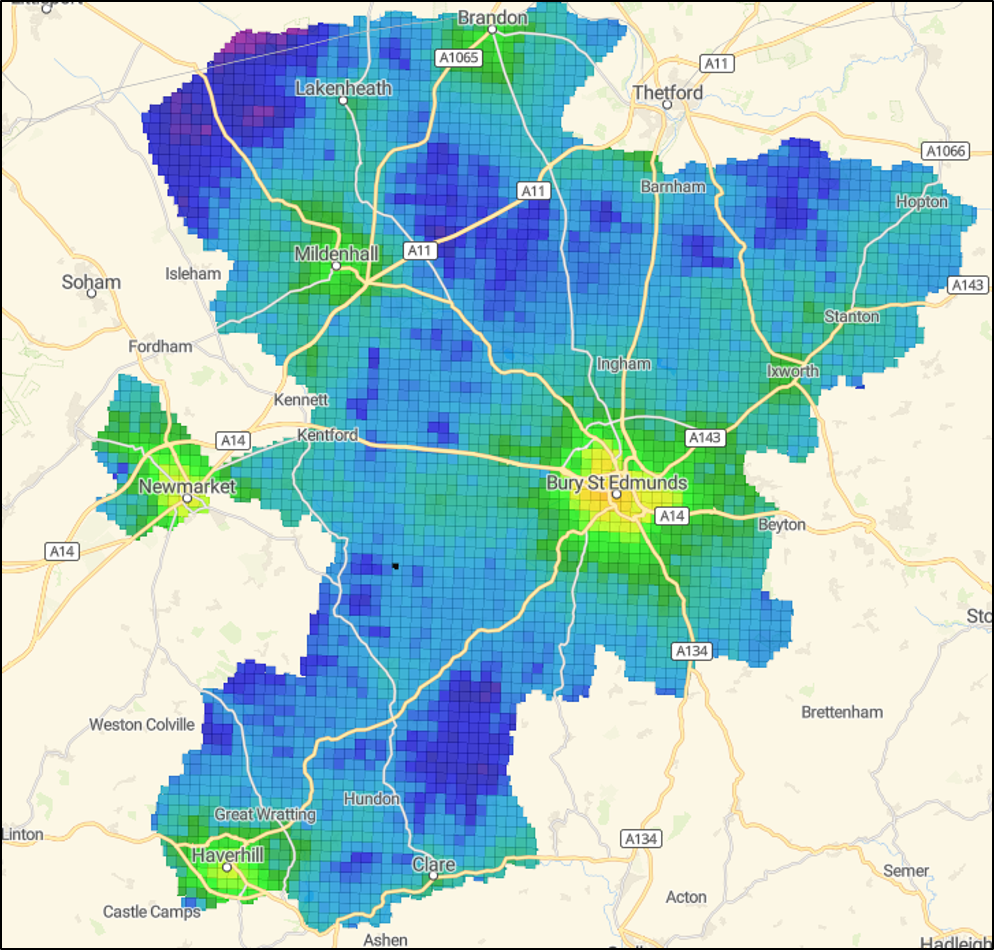
Source: Connectivity Tool
Digital connectivity
6.23. As population growth is expected to lead to an increased demand for facilities and services throughout West Suffolk, and broadband has become a key infrastructure requirement.
6.24. The West Suffolk Strategic Environmental Assessment (SEA) Report 2026 highlights that digital deprivation is most apparent in rural areas of the district (SEA report page 18).
6.25. Digital deprivation refers to the inability to fully access, use, or benefit from digital technologies, creating social and economic inequalities.
6.26. With increasing reliance on digital services (for example, online healthcare, remote education), ensuring equal access to digital infrastructure for all residents, including older and disabled groups, is important for reducing inequality in service access.
6.27. Full fibre broadband is available to 72.6 per cent of all properties in West Suffolk and this is slightly below the average (75.5 per cent) for all local administrative units in the UK. Despite having generally good full fibre broadband provision, 0.1 per cent of all properties in West Suffolk fall below the obligation specified in The Electronic Communications (Universal Service) (Broadband) Order 2018, of at least 10 megabits per second download speed and one megabit per second upload speed.
6.28. As digital infrastructure improves, ensuring equal access to digital services (for example, online healthcare appointments, remote education) will become increasingly important. Addressing digital accessibility within the more rural areas of the district, especially for older residents and those with disabilities, will be a priority.
Back to West Suffolk Local Plan 2045 Baseline Data 2026 homepage