
3. Levels of deprivation in West Suffolk
Key baseline data sources used in this section
- West Suffolk Strategic Environmental Assessment (SEA) Scoping Report 2026
- Index of Multiple Deprivation (IMD) | Local Deprivation Explorer 2025
3.1. The Index of Multiple Deprivation (IMD) is an official relative measure of deprivation in England for small areas known as Lower Super Output Areas (LSOAs). There are 107 LSOAs in West Suffolk. The IMD ranks these areas based on factors such as income, employment, education and health. (IMD, 2025).
Figure 10: shows English Indices of Deprivation 2025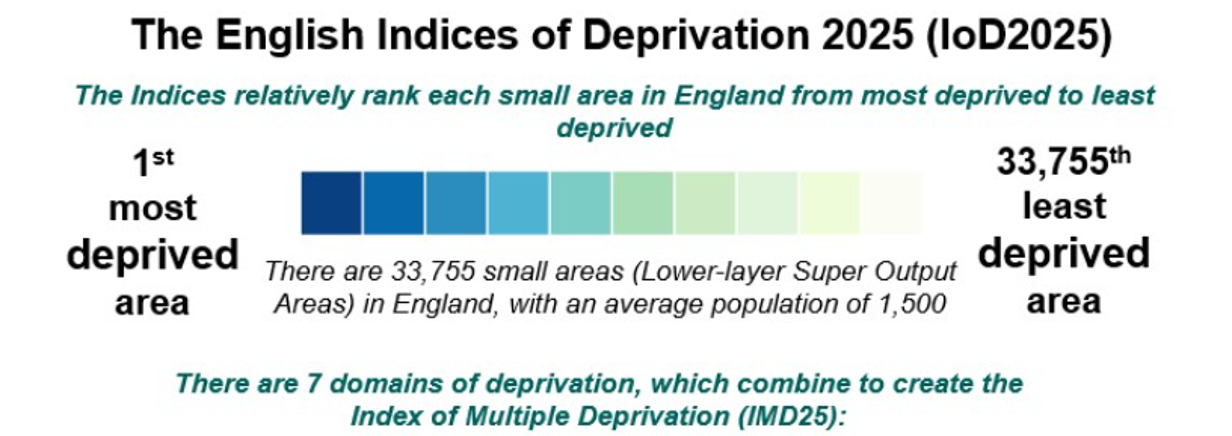
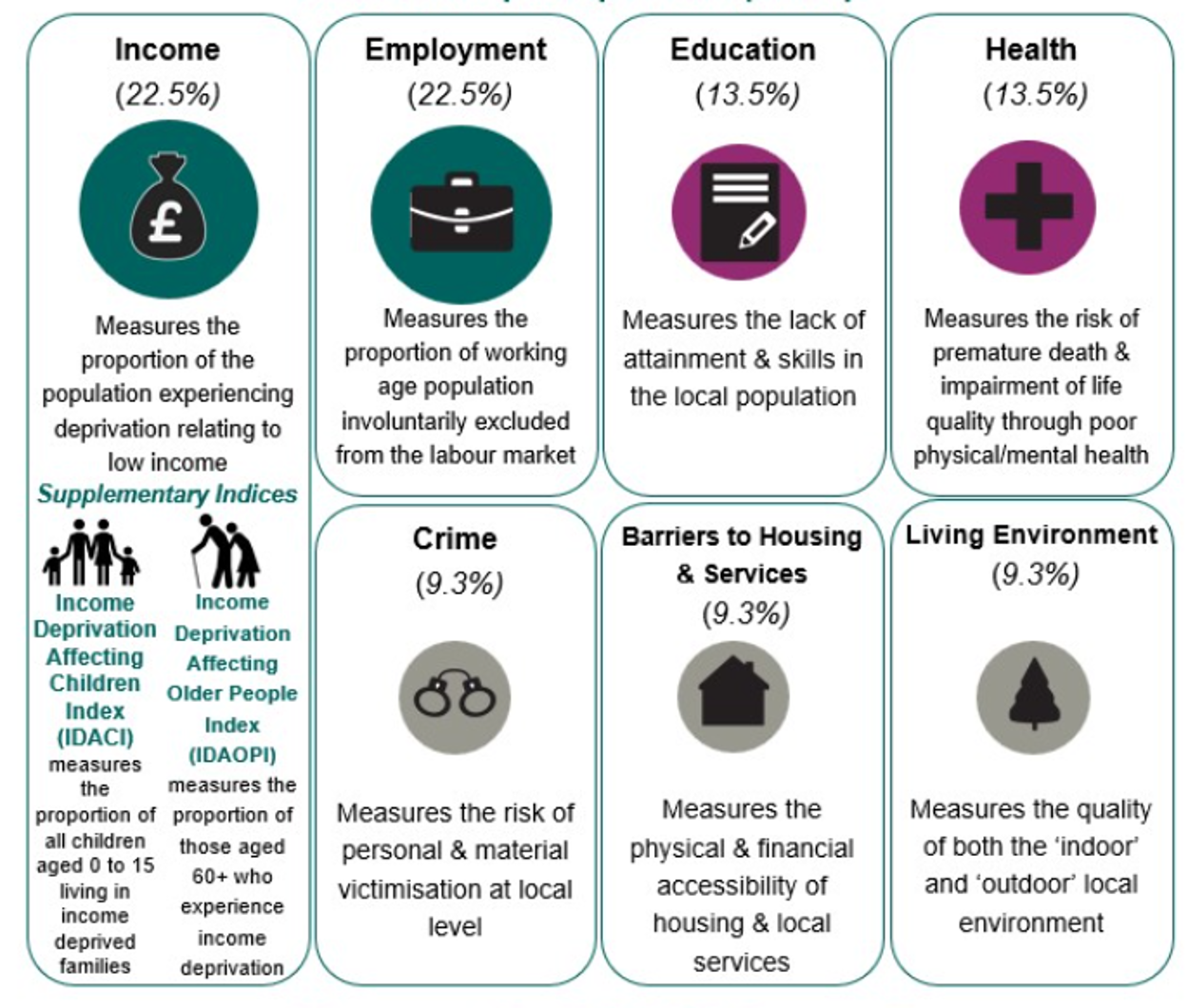
Source: Local Deprivation Explorer
3.2. The index of multiple deprivation 2025 is comprised of seven distinct domains of deprivation which, when combined and appropriately weighted form IoD2025. They are; income (22.5 per cent), employment (22.5 per cent), health deprivation and disability (13.5 per cent) – education, skills training (13.5 per cent), crime (9.3 per cent), barriers to housing and services (9.3 per cent), living environment (9.3 per cent).
Local indicators
3.3. When looking at ranking of local authority districts across England in England in the index of multiple deprivation, West Suffolk ranks 172 out of 296 and is less deprived than 58 per cent of local authority districts in England. However, these rankings fail to show pockets of deprivation in the district. Areas within Bury St Edmunds, Newmarket, Mildenhall and Haverhill being more deprived than 80 per cent up to 87 per cent of neighbourhoods in England. (Index of Multiple Deprivation (IMD), 2025).
Figure 11: image showing the overall index of multiple deprivation 2025 and overall indices of deprivation ratings for West Suffolk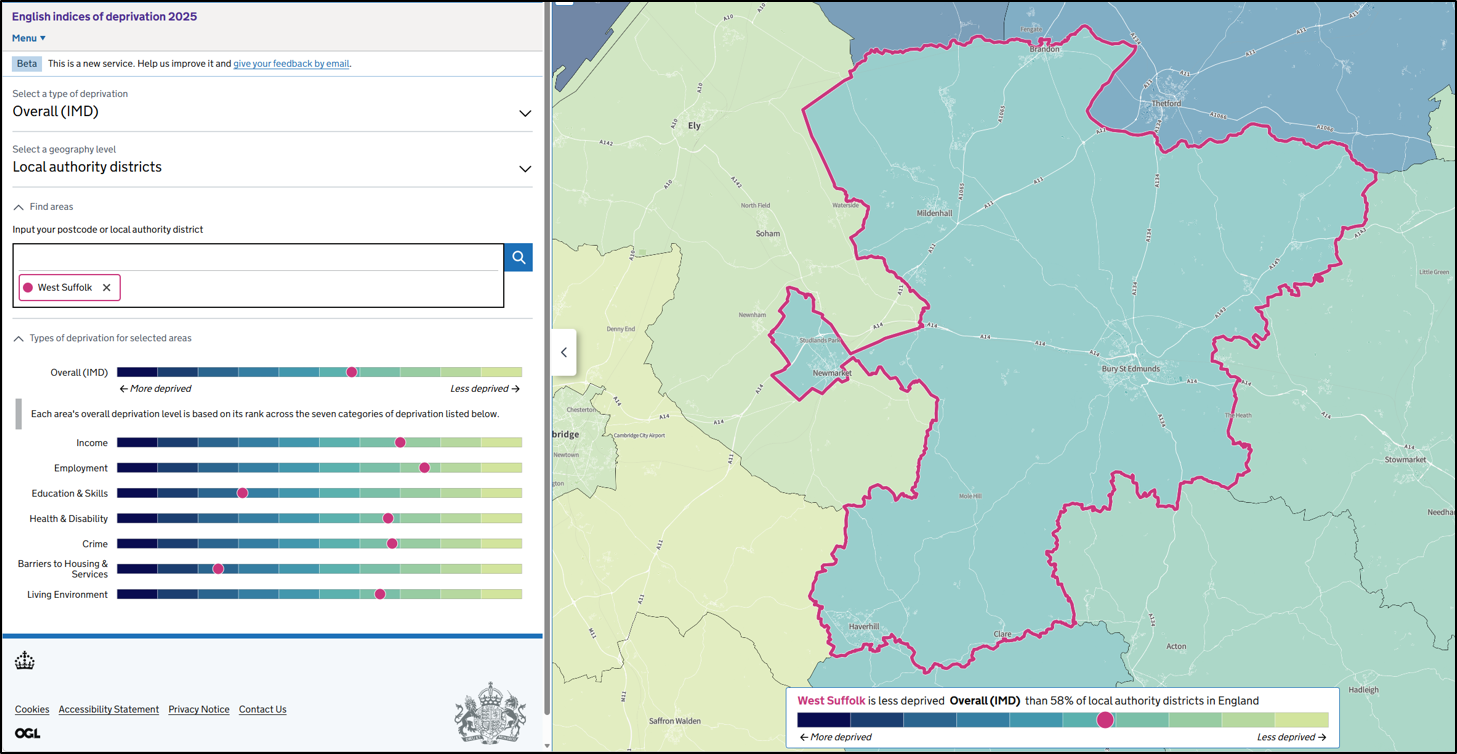
Source: Overall - Index of Multiple Deprivation (IMD) | Local Deprivation Explorer
3.4. West Suffolk’s rankings across the seven deprivation domains and two supplementary indices are summarised below.
- Income deprivation: the proportion of residents on low incomes. West Suffolk is less deprived than 70 per cent of local authority districts in England.
- Employment deprivation: the proportion of working-age people excluded from the labour market through unemployment, sickness, disability or caring responsibilities. West Suffolk is less deprived than 76 per cent of local authority districts in England. This is covered further in the local economy and employment chapter.
- Education and skills deprivation: a measure of educational attainment and skills. West Suffolk is more deprived than 69 per cent of local authority districts in England, making this one of its most deprived domains. This is covered further in the local economy and employment chapter.
- Barriers to housing and services deprivation measures the physical and financial accessibility of housing and local services, including housing affordability, overcrowding, digital connectivity and distance to services such as GP surgeries and schools.
West Suffolk is more deprived than 75 per cent of local authority districts in England for this domain. Higher levels of deprivation are concentrated in rural areas, with lower levels in urban areas. This domain is covered further in the sections on housing affordability and digital connectivity. - Health and disability deprivation measures the risk of premature death and reduced quality of life linked to poor physical or mental health. West Suffolk is less deprived than 67 per cent of local authority districts in England.
- Crime deprivation: measures the risk of personal and property crime. West Suffolk is less deprived than 68 per cent of local authority districts in England.
- Living environment deprivation: measures housing quality and aspects of the outdoor environment, including air quality and road traffic accidents. West Suffolk is less deprived than 65 per cent of local authority districts in England.
- Income deprivation affecting children measures the proportion of children aged 0 to 15 living in income-deprived families. West Suffolk is less deprived than 69 per cent of local authority districts in England.
- Income deprivation affecting older people measures the proportion of people aged 60 and over experiencing income deprivation. West Suffolk is less deprived than 63 per cent of local authority districts in England.
3.5.. Indices of deprivations not covered in this report can be explored further on the Overall – Index of Multiple Deprivation (IMD) | Local Deprivation Explorer or in the West Suffolk Strategic Environmental Assessment (SEA) Scoping Report 2026.
Back to West Suffolk Local Plan 2045 Baseline Data 2026 homepage