
4. Local economy and employment in West Suffolk
Key baseline data sources used in this section:
- West Suffolk Strategic Environmental Assessment (SEA) Scoping Report 2026
- Active businesses 2025 - Office of National Statistics (ONS)
- Employment rate (Great Britain) - ONS
- Economic activity status - Census Maps (ONS)
- Suffolk Observatory - Economy and Employment - Area reports
- Nomis - Query Tool - Business Register and Employment Survey: open access
- Employment | Local Deprivation Explorer
- Education and Skills | Local Deprivation Explorer
- West Suffolk Council's Strategic Priorities 2024-28
- Case for Change - Three Councils For Suffolk
- West Suffolk Employment Land Review 2021
- West Suffolk Retail and Town Centre Uses Study 2022
Economic profile for West Suffolk
4.1. West Suffolk is a largely rural district, with concentrations of economic activity in Brandon, Bury St Edmunds, Haverhill, Mildenhall and Newmarket.
4.2. In 2024 West Suffolk recorded 8,020 active businesses representing growth of 9.3 per cent since 2019. (Office of National Statistics, 2025).
Figure 12: shows that the size distribution of enterprises by the number of employees in West Suffolk is comparable to the regional and national average.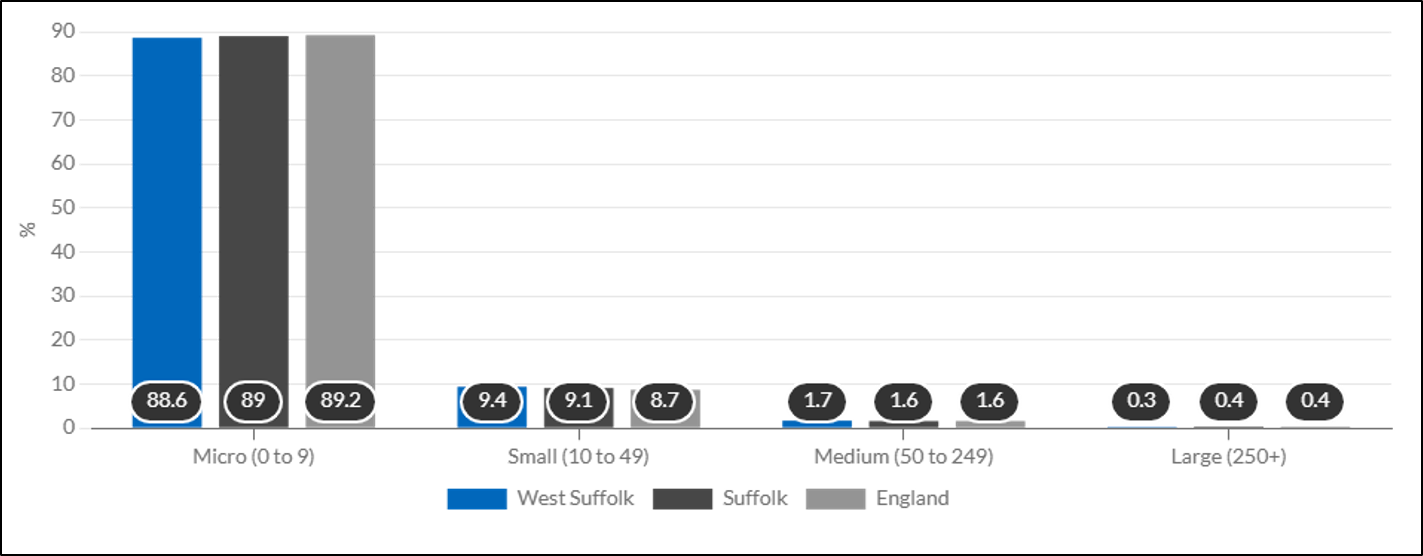
Source: Suffolk Observatory
4.3. West Suffolk’s mix of industries is above the national average for agriculture, forestry and fishing, arts recreation and other services. The district is comparable to the national average in manufacturing, construction, retail, business admin and support services and accommodation and food services (among others). The mix of professional, scientific and technical and information and communication sectors are below the national average.
Figure 13: Shows the percentage of enterprises by industry in West Suffolk in 2025 compared to England average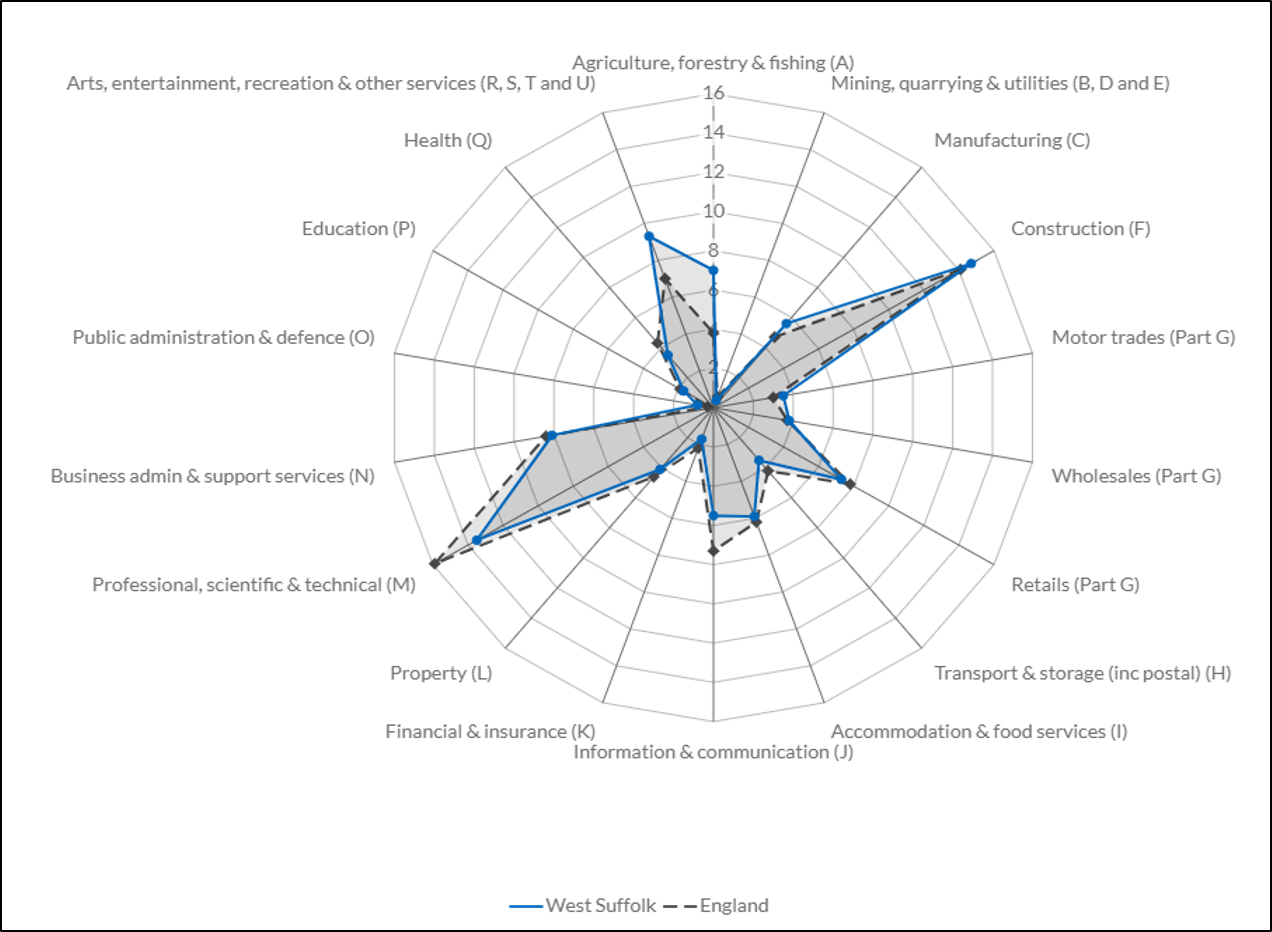
Source: Suffolk Observatory
4.4. West Suffolk has strengths in agritech, agrifood, biotechnology, food and drinks processing, with a strong brewing industry concentrated around Bury St Edmunds. Proximity to Cambridge bestows on West Suffolk as a focus for the biotechnology sector, especially concentrated around Haverhill, which has established major biotechnology employers and a large industrial estate and business park.
4.5. The strongest focus of industrial activity is around Bury St Edmunds and adjacent to the A14, which is home to some larger manufacturing companies. There are also clusters of industrial activity along the A143.
4.6. West Suffolk is home to three RAF bases: RAF Lakenheath, RAF Mildenhall and RAF Honington, the first two being occupied by United States Airforce in Europe (USAFE). Newmarket is the headquarters of the British Horse Racing Industry, employing over 3,200 full-time equivalent jobs.
4.7. In order to anticipate and respond to the longer-term vision and further opportunities for economic growth along the A11 and A14 corridors in the next 30 years, the council will work with its partners to explore and deliver opportunities for sustainable growth whilst working within the environmental constraints and the prevailing legislation, with the aim to attract high value jobs and create a diverse economic base so that businesses in the district can invest, expand and adapt.
Employment
4.8. Data from the Government’s Inter Departmental Business Register (2021) shows how employment is concentrated in these main towns: 40 per cent of employment is in Bury St Edmunds, 15 per cent in Newmarket, 12 per cent in Haverhill, five per cent in Mildenhall and three per cent in Brandon. The remaining 25 per cent is distributed throughout the rural wards of the district.
4.9. In West Suffolk the number of employed residents (excluding full-time students) fell from 61.1 per cent in 2011 to 59.2 per cent in 2021, a decrease of 2.6 per cent, likely due to national lockdown, furlough schemes, and wider disruption affected labour market during the COVID-19 pandemic. This was noticeably larger than the national fall of 0.8 per cent over the same period (from 56.5 per cent to 55.7 per cent). During the same period the percentage of people aged 16 years and over who were retired (economically inactive) rose 1.1 per cent to 23.5 per cent in 2021, reflecting the area’s ageing population profile. (Office of National Statistics (ONS), 2021)
4.10. The West Suffolk employment land review update displays a future economic forecast for the district and expects an increase in jobs of between 11,400 and 11,700 between 2024 and 2041.
4.11. Since 2023 the employment rate in West Suffolk has been well above national average for people ages 16 to 64, bouncing back from the 2008 financial crisis to a steady rate above 80 per cent between 2012 to 2020. As shown in figure 15, the employment rate dropped drastically to 76 per cent in 2021, likely due to the COVID-19 pandemic, and settling at 77.3 per cent in 2023. This employment rate is now close to the national average, however still slightly higher.
Figure 14: line chart comparing the employment rate in percentage of people age 16 to 64 in West Suffolk to national average, from 2004 to 2023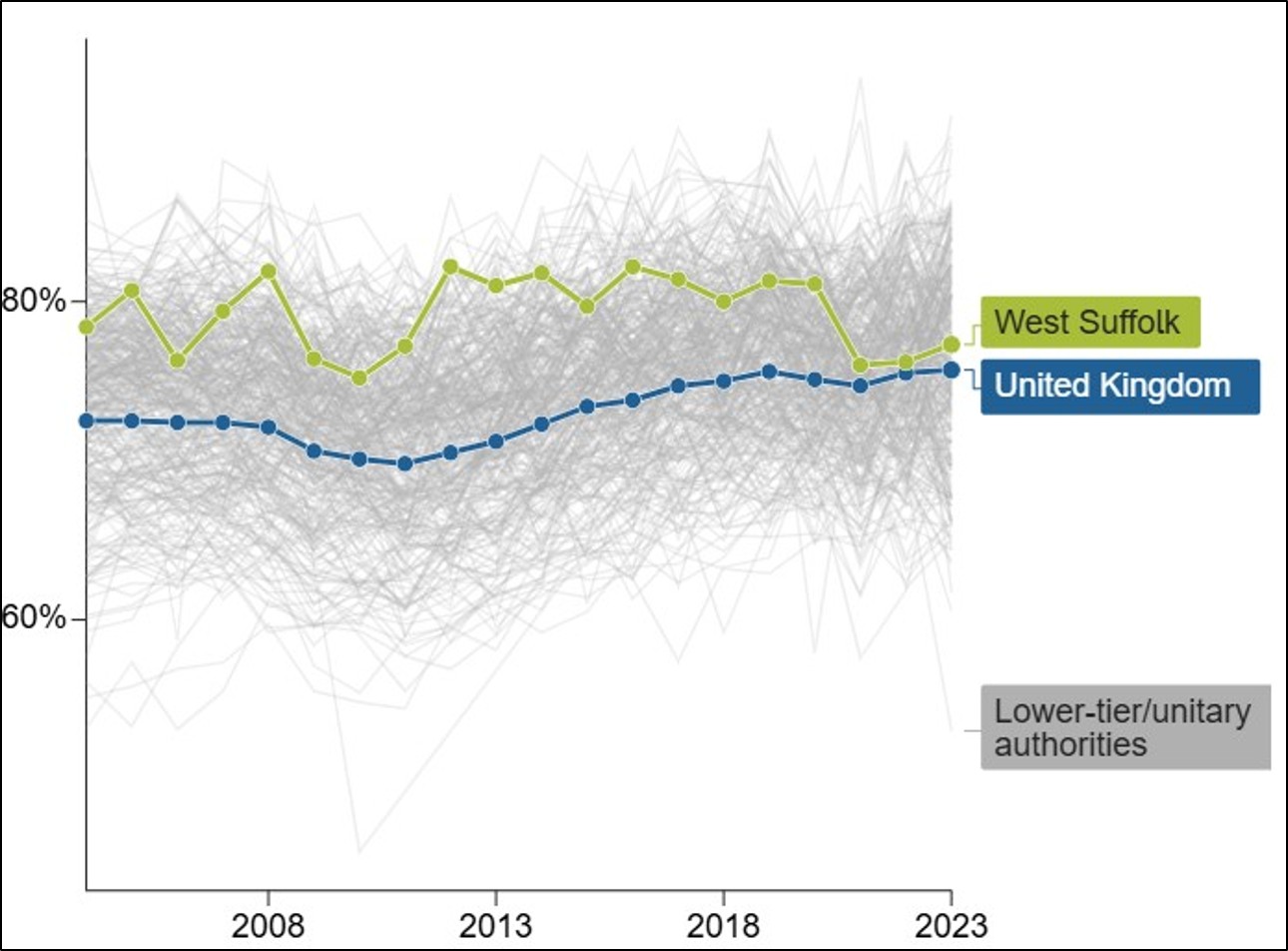
Source: Employment rate (Great Britain) - Office of National Statistics (ONS)
4.12. A comparatively high proportion of workers are employed in skilled trades and in sales and customer services occupations, as illustrated in figure 16. Table 1 show the number of individuals estimated to be working in each industry from 2020 to 2024. Combined with figure 16 this shows a lower proportion of residents working in professional occupations than national averages, likely linked to comparatively lower levels of formal qualifications within the district as highlighted in the previous chapter.
Figure 15: radar chart showing the employment in percentages by industry for West Suffolk in 2024 compared to England average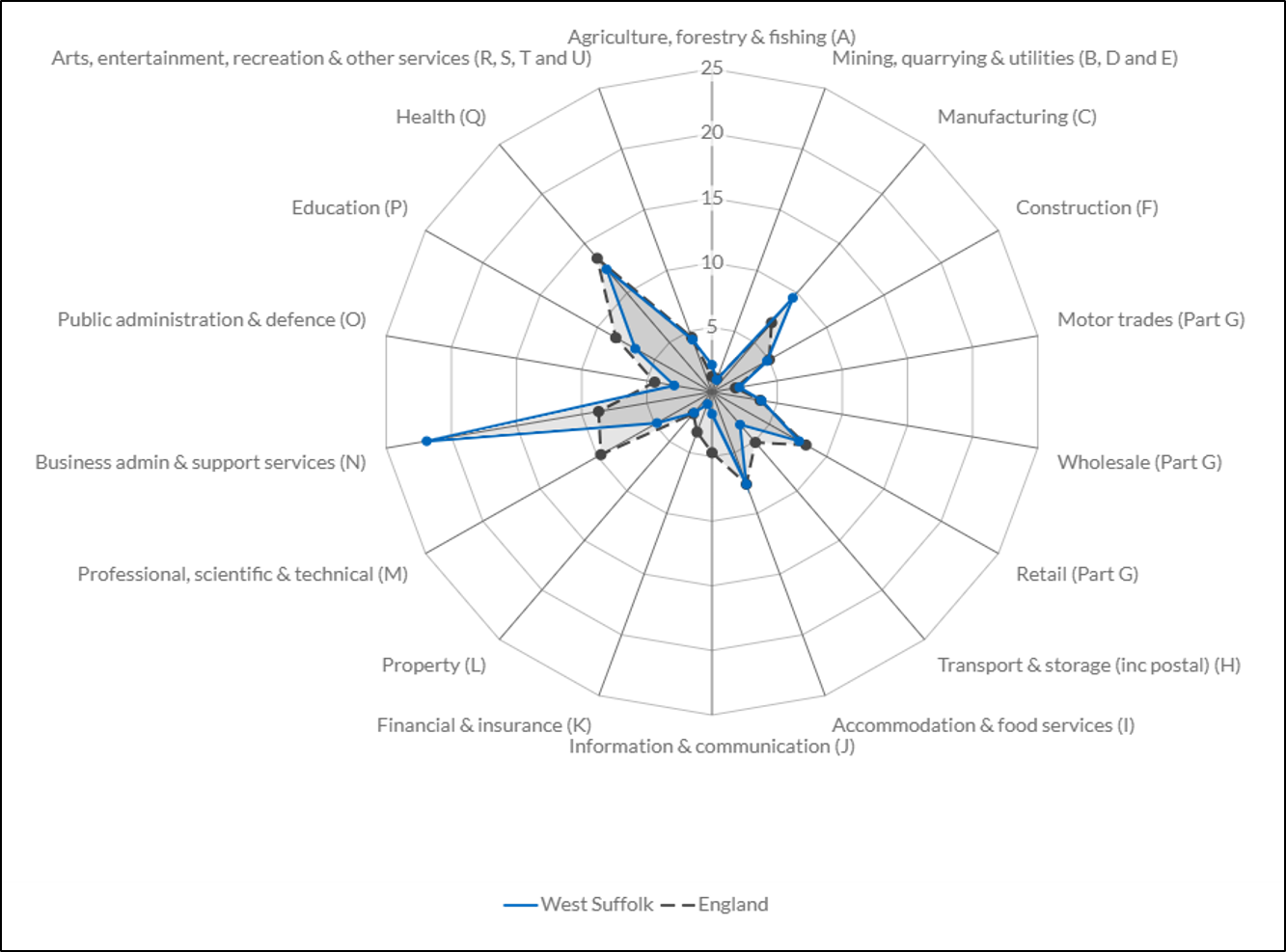
Source: Suffolk Observatory
Table 1: shows estimated number of employees by industry from 2020 to 2024
| Industry | 2020 | 2021 | 2022 | 2023 | 2024 |
|---|---|---|---|---|---|
| 1: Agriculture, forestry and fishing | 2,500 | 2,500 | 2,500 | 2,250 | 2,250 |
| 2: Mining, quarrying and utilities | 1,000 | 1,000 | 900 | 1,000 | 1,000 |
| 3: Manufacturing | 9,000 | 9,000 | 9,000 | 10,000 | 10,000 |
| 4: Construction | 5,000 | 5,000 | 5,000 | 5,000 | 5,000 |
| 5: Motor trades | 2,250 | 2,000 | 2,250 | 3,000 | 2,250 |
| 6: Wholesale | 4,000 | 4,000 | 4,000 | 4,000 | 4,000 |
| 7: Retail | 9,000 | 9,000 | 8,000 | 8,000 | 8,000 |
| 8: Transport and storage (including postal) | 3,500 | 3,500 | 3,500 | 4,000 | 3,500 |
| 9: Accommodation and food services | 7,000 | 7,000 | 8,000 | 8,000 | 8,000 |
| 10: Information and communication | 1,500 | 1,500 | 1,500 | 1,500 | 1,750 |
| 11: Financial and insurance | 1,750 | 1,500 | 1,500 | 1,500 | 1,000 |
| 12: Property | 2,000 | 1,250 | 1,500 | 2,000 | 2,250 |
| 13: Professional, scientific and technical | 5,000 | 5,000 | 4,500 | 5,000 | 5,000 |
| 14: Business administration and support services | 22,000 | 22,000 | 21,000 | 22,000 | 23,000 |
| 15: Public administration and defence | 3,000 | 3,000 | 3,000 | 3,000 | 3,000 |
| 16: Education | 7,000 | 8,000 | 7,000 | 7,000 | 7,000 |
| 17: Health | 12,000 | 12,000 | 13,000 | 13,000 | 13,000 |
| 18: Arts, entertainment, recreation and other services | 4,000 | 5,000 | 4,500 | 4,500 | 4,500 |
| Total employment in West Suffolk | 101,500 | 102,250 | 100,650 | 104,750 | 104,500 |
Source: Office of National Statistics (ONS) Crown Copyright Reserved [from Nomis on 24 April 2026]
4.13. Overall, West Suffolk performs well compared to other local authorities nationally for employment deprivation ranking 226 out of 296, and being 76 per cent less deprived compared to other local authorities. Only 25 per cent of West Suffolk’s lower super output areas rank within the 50 per cent most deprived areas national for employment, with 11 of those being outside the 40 per cent most deprived. The district also contains no lower super output areas considered to be in the top 10 per cent most deprived for employment. Deprivation hotspots are mostly concentrated around urban areas in Bury St Edmunds, Newmarket, Mildenhall, Brandon and Haverhill. (Employment local deprivation explorer, 2025).
Employment land demand, supply and delivery
4.14. West Suffolk Employment Land Review (WSELR) study was published in November 2021 with an addendum published in May 2022 and a further Employment Land Review Update in 2024. It has assessed existing employment provision and future need for employment land in the district to 2041. The West Suffolk Employment Land Review (ELR) update (2024) projected 0.5 to 0.6 per cent annual economic growth between 2024 to 2041 and also identifies a need for a total of 86 hectares of land to accommodate the forecasted growth.
4.15. To meet the need for a total of at least 86 hectares of land to accommodate employment development between 2024 and 2041, a total of around 90 hectares is identified in the adopted local plan within general and rural employment areas (total five hectares) and on-site allocations (total 85 hectares). This provision will address employment needs for offices, research and development, light industrial, general industrial and storage and distribution.
4.16. The adopted local plan spatial strategy focusses economic growth to the most sustainable locations where constraints allow. Appendix C in the West Suffolk Local Plan sets out a schedule of all the strategic, employment, mixed-use and residential site allocations in the plan. New employment site allocations are focused on the towns where there is strongest demand (Bury St Edmunds, Haverhill, Newmarket and Mildenhall), and a small amount of rural provision.
4.17. The West Suffolk Employment Land Review Update (WSELR) notes that the district’s smaller light industrial and office users are in risk of being left short of modern supply. The WSELR shows that between 2009 and 2023 there has been take-up of 73.26 hectares (ha) of employment land in the district. A good majority of this figure (35ha) comes from a recent Suffolk Business Park extension in Bury St Edmunds in 2022, which should contribute towards addressing demand for employment land in the area. Between 2013 to 2014 and 2022 to 2023 a total of 4.38ha of employment land has been lost in the district. (West Suffolk Strategic Environment Assessment (SEA) Scoping Report 2026 page 85)
4.18. Homeworking, self-employment, and home-based businesses is likely to shape West Suffolk’s economic landscape. While there is a returning demand for in-person presence from businesses since Covid-19, remote and hybrid working models might become more embedded, and there may be increased demand for co-working spaces, digital infrastructure, and local business hubs. However, it is still too early to say if this shift is permanent.
4.19. Data for completed employment projects is currently not public domain information, and an updated table will follow.
Education and skills
4.20. The local indices of deprivation (IoDs) data shows that West Suffolk is more deprived in education and skills than 69 per cent of local authority districts in England, ranking 93 out of 296. One lower super output area in Bury St Edmunds ranking as low as 1576 out of 33,755.
4.21. Over 57 per cent of the districts lower super output areas rank within the 50 per cent most deprived areas nationally for education, skills and training, with 22 of these in the bottom 20 per cent. The most deprived areas are concentrated to the north of the district and in areas surrounding urban settlements. (Strategic environmental assessment report page 80).
4.22. Suffolk’s education institutions, including West Suffolk College, are investing in the future workforce. With a strong focus on science, technology, engineering, and mathematics (STEM), digital industries, healthcare, and technical apprenticeships, Suffolk is equipping its talent pipeline to meet the demands of high-growth sectors and ensure long-term economic resilience.
4.23. The 2021 Census indicates that in the district, 28.5 per cent of residents aged 16 and above have a level 4 qualification and above. This is broadly in line with county levels (28.1 per cent) but below national levels (33.9 per cent). There are also a greater proportion of residents with no qualifications (20.9 per cent) compared to county (19.7 per cent) and national (18.0 per cent) averages.
4.24. The relatively lower levels of qualifications in West Suffolk may have implications for local economic growth and employment opportunities. A workforce with fewer higher-level qualifications may limit the district’s ability to attract certain high-value industries and knowledge-based businesses. Sectors that require lower formal qualifications, such as skilled trades and administrative roles, may remain dominant within the local economy, as currently seen in figure 16 and table 1.
Retail and town centres
4.25. The town centres provide a wide range of service and facilities to our communities, as places to meet, work, shop and play. Towns such as Bury St Edmunds act as popular visitor destinations due to their heritage assets, street markets, and thriving town centre.
4.26. The West Suffolk Retail and Main Town Centre Uses Study (May 2022) assessed the existing retail and main town centre use provision and future quantitative and qualitative need for new retail and commercial leisure floorspace in the district to 2040. The study has defined the retail hierarchy, from town centres including Bury St Edmunds, Haverhill, Newmarket, Brandon, Mildenhall and Clare to the smallest our local centres which serve the local communities.
4.27. The study’s forecast retail capacity assessment considered there was no need to plan for new retail floorspace over the period to 2040 for the district, with exception to only a limited quantum of floorspace capacity for non-food retail identified for Mildenhall, Newmarket and Brandon.
4.28. The policies in the local plan continue to promote the long-term vitality and viability of the town and local centres in West Suffolk.
Back to West Suffolk Local Plan 2045 Baseline Data 2026 homepage